
The Issue of Race While Married to a Narcissist

Photo by Clay Banks on Unsplash

There are many things you have to deal with while being married to a narcissist. With all of the gaslighting, blame shifting, emotional and verbal abuse a narcissistic relationship entails, that’s enough to handle just by itself. But, when you’re an interracial couple and your partner is a narcissist, there’s an additional challenge to endure. Especially, when you are an African American female married to a Caucasian male in America. That challenge can create even more difficulty after the relationship ends. Unexpected challenges that could not be predicted but were there all along and present themselves over time in the most toxic ways.

The Beginning

I met my ex-husband through online dating. He was from small town America with a population so small it couldn’t even be defined as a city. Needless to say, there was little to no diversity in this town and more than likely a lot of very old stereotypes helped lay the foundation for this community. The local high school science teacher actually taught the kids African Americans can jump high playing basketball because they have an extra bone in their feet. I don’t know if it was his fascination with people of color or his curiosity that enticed him to date outside of his race but whatever the reason he set his sights on me.

His first interracial relationship was with a Hispanic female in high school. His parents immediately put the hammer down on that relationship citing, “she was using him.” She was from a poor family and he could do better was the narrative. “Poor’’ meant a minority wrapped in an economic status that placed the woman of his affections as a negative just by existing in her racial makeup and current economic state.

Fast forward, five years later and I meet this innocent looking young man on a dating site. He doesn’t list his location as his small town, he lists the location he’s moving to. My city, over 500 miles away. He moved to my city not long after we met online. We met, we dated, and we fell in love. Or, so I thought. There were a number of red flags along the way that really made me question if he ever really loved me. When you consider how narcissists prey on their potential victims and become everything a potential mate is looking for in a significant other, it really makes you question the true authenticity of your relationship. It’s been said that narcissists are incapable of love and based on my experience, I’m inclined to believe that.

The Stigma of Interracial Dating

When my ex-husband first introduced me to his family. His mother was immediately dismayed. What would the neighbors think was her first reaction? Then, she went into the stigma of the kids and how society would never accept them. We were essentially intentionally sending our kids to damnation by choosing to bring them into this world. She cried for days and days constantly trying to convince her son to break up with me (one of many red flags I missed — narcissistic mother). Now, on top of all the issues of being with a narcissist, you now have the additional toxicity of racism added to it.

The Narcissist Emerges

As the years progressed, I noticed changes in the man I married. He became very controlling and emotionally abusive although at the time, I didn’t know what to call what I was experiencing in my marriage. I thought his maltreatment of me was my fault. He also displayed extreme favoritism to our daughter and treated my son horribly.

As my son progressed into his teenage years, he began to grow his hair out and became interested in hip hop music. “You need to cut your hair,” my ex-husband would repeatedly tell him. “Why do you have that ‘fro?” “Turn off THAT music!” If my son turned on a hip hop or R&B song on the radio in the car, the station was immediately changed. “We’re not listening to that nonsense!” My ex-husband would sneer as if my son was doing something wrong or illegal. Etched into these behaviours and responses is the family that enabled him and perpetuated stereotypes that he never relinquished, despite the fact that he married and had children with me. In some way, he was saving me by marrying me and taking me into a new, better status. In reality, I was the upgrade that uplifted his social and economic status.

Racial Identity Denied

When I tried to teach my kids about African American history and their culture, I was immediately shut down. “Why does everything have to be about race?” He would often say denying my kids a part of who they were. He even went so far as to put their racial identity as “white” on application forms whereas I always identified them as both races never denying their racial makeup.

My children grew up terrified to be themselves in their own home. In addition to having to survive the consistent put downs and live up to the unrealistic standards set by their father, they couldn’t embrace their own identities. They scurried to turn off music if dad walked into their room and changed the TV station if it was tuned to an urban show. Everything they enjoyed related to their culture had to be a secret to avoid dad’s wrath.

Not only did my children have to grow up dealing with a father who went into narcissistic rages at the drop of a dime, gaslighted and made them feel inadequate in every shape or form, but they grew up having to hide their racial identity in their own home. Something no child should ever have to experience.

Newfound Strength

I finally found the strength to leave my marriage after 16 years of abuse. I am proud of my children for finding their own identity despite the roadblocks their dad threw at them along the way. They continue to learn about their African American heritage and are finally free to be themselves. I still feel guilty for subjecting my kids to years of abuse, but I can’t beat myself up forever. I too was trying to survive in a household where you continuously walked on eggshells trying to avoid that next episode of narcissistic rage terrifying you into submission.

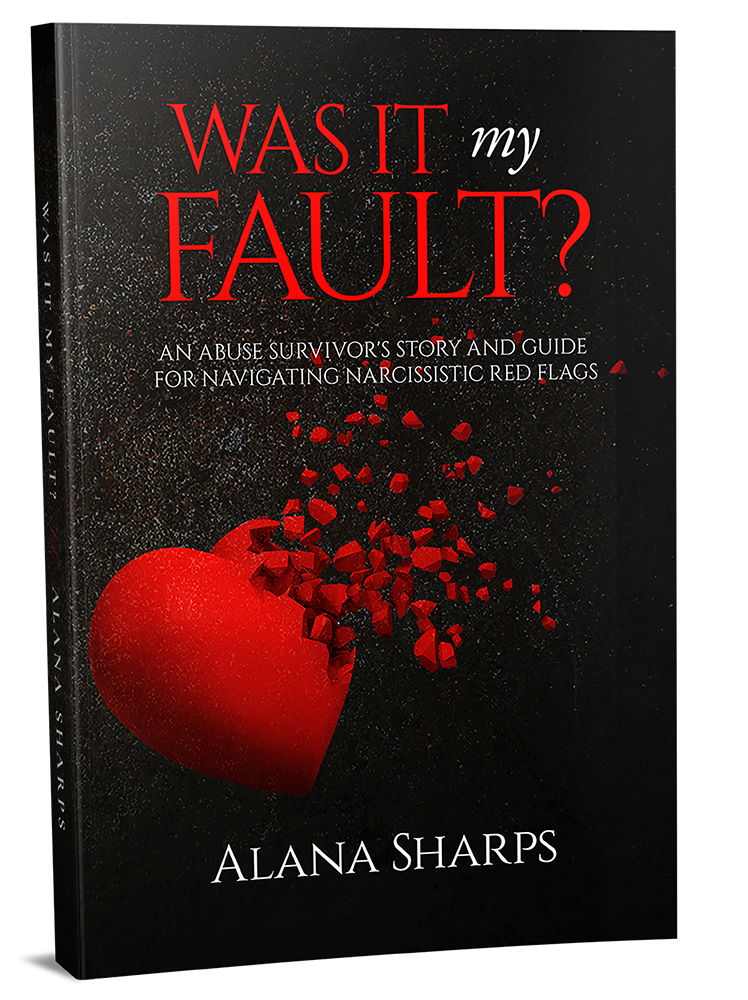
Was it My Fault, now available. Click here to order my book.
Featured

Reclaiming My Life After Narcissistic Abuse

Life in an abusive relationship isn’t something we ever think about until it happens to us. We grow up believing it could never happen to us. We tell ourselves that’s something that happens to “those people”. We fool ourselves into believing we’d never put up with behavior that makes us feel less than someone else.

These are great ideals, but unfortunately, for many people, like me, it’s a pipe dream. Through no fault of our own, some end up in relationships like this. The toxicity with niceties, attention, kind words, overt acts of love like gifts, trips, and all the sweet things that bring smiles to our faces.

Soon, those niceties become few and far between. What was once loving looks turns to scowls. The kind words are replaced by name calling, insults, threats, and outright frightening declarations. While shocking at first, it’s amazing how quickly this abhorrent behavior becomes our new normal. We make excuses as our abuser chips away at our self-esteem, makes us question ourselves, and fundamentally changes our perception.

Some people live with this for decades. Some, like me, leave… eventually. But unfortunately, leaving doesn’t always end the abuse. The abuser will sometimes find a new way to manipulate or control you. The system that’s designed to help you sever ties and clean up loose ends also works against you.

My book, my story, chronicles my journey from an abusive relationship to fighting for my life back and the aftermath of taking a stand. While not a pretty story, this raw account is meant to help anyone, who is living in this near-impossible situation, navigate the sometimes-confusing road ahead. Whether it be the legal system or beyond, I know it would’ve been helpful to have a roadmap to help me navigate this treacherous terrain.

After surviving narcissistic abuse and fighting to get my life back, improve my self-esteem, and reclaim the pieces of me that had been chipped away after sixteen years in a toxic relationship, the last thing I needed was another battle for what was rightfully mine. When the legal system is set up to work against you and not take your best interests into account, where do you turn?

My book outlines the steps I took and those I encourage those I consult to take. While I’m not an attorney, I know from experience what worked for me. It’s my hope that my book, my story, my journey will provide inspiration, help you create a roadmap to the next chapter of your life, and provide you with the tools you need to succeed on the other side of an abusive relationship.

Was it My Fault, now available. Click here to order my book.

The Detrimental Impact of the Narcissistic Parent

Most women desire the fairytale relationship portrayed in movies. There’s this highly gratifying and comforting sense around the Hollywood version of love. You fall in love with prince charming, get married and start a family or some variation of that theme. However, in reality, sometimes that prince charming turns out to be a wolf in sheep’s clothing. It completely catches you off guard wondering what went wrong and how to fix it. Prince charming, to your surprise, is a covert narcissist. Charming and charismatic to the outside world almost to the point of a fictional comparison. Behind closed doors, the princely robes come off to reveal the monster underneath. 

The Scapegoat and the Golden Child

As you start building your family, you begin to see more subtle changes in your spouse. One child is overwhelmingly doted on and placed on a pedestal while another child is treated like a trash bin collecting all of the narcissist’s negative feelings. He specifically decides based on his own arbitrary rules who gets to be golden and who gets to be the scapegoat. 

The scapegoat is blamed for everything that goes wrong in the narcissist’s life. They are made to feel inadequate and nothing they do is ever right in the narcissist’s eyes. The golden child, on the other hand, is the “perfect” one. Nothing they do is wrong, and they are the apple of the narcissist’s eye. When they misbehave, they are never disciplined while the scapegoat is overly disciplined even in the face of evidence where both children are responsible.

As their mother, you see the difference in how they’re being treated. You voice your concerns to your spouse who gaslights you into believing you are crazy. You’re also caught up in your own battle of survival trying to avoid bouts of narcissistic rage by walking on eggshells in the presence of the narcissist. All it takes is one phrase or utterance to set the narcissist off. 

The Aftermath

Siblings in a narcissistic family are bonded by emotional trauma. They experience psychological warfare that most people wouldn’t understand or believe based on the covertness of the narcissist. The children’s sense of self-worth is so psychologically beaten out of them that it takes a long time to get it back if they are fortunate enough to do so.

The covert narcissistic parent is subtle in their emotional abuse of their children, using insinuations and subtle daggers difficult for their children to recognize. The kids are left with the impression that they aren’t good enough because they aren’t doing whatever it is the narcissistic parent is visualizing in their head. Unfortunately, the children then end up confused from the gaslighting, making them feel like a failure or inadequate, needing to strive harder to earn the love and approval of the narcissistic parent. This is exactly the goal of the covert narcissistic parent. To make new supply/victims, suppress opposition and create chaos. To them, children are and will be used as tools for the narcissist’s needs.  

The golden child develops a scattered sense of identity. Their narcissistic parent’s thoughts and feelings become their own, interfering with the child’s proper development of self. The parent expects the child to mirror all of their traits, and the child, wanting to please the parent, follows suit. The child has difficulty with their own thoughts, feelings, and opinions and typically has difficulty thinking for themselves. As a result, the child struggles with boundaries. Since the parent has no boundaries with the child, the child either grows up with zero boundaries and gets taken advantage of by others, or has such strong boundaries that they don’t let anyone in.

The scapegoat acts out in school, lashes out at others and develops extremely low self esteem. They feel that everything they do is wrong and nothing they do is ever enough.

Both children often develop severe anxiety anticipating the next narcissistic rage and wanting to avoid it at all costs, trying to conform to whatever the narcissist wants or needs. This anxiety bleeds into their everyday interaction with others. 

The children also typically develop severe depression and have suicidal thoughts. Both the golden child and the scapegoat lack self-esteem from constant criticism, demeaning remarks, and subliminal messages thrown at them from the narcissistic parent. If the children are not provided mental health therapy during childhood, their trauma can lead to trouble in their adult life. Most children require trauma therapy from a trained trauma therapist, preferably familiar with narcissism, to heal from their childhood upbringing. 

Narcissistic parents psychologically damage their children


Was it My Fault, now available. Click here to order my book.

Photo by Kat J on Unsplash